- Public Address & Background Music Systems
- Lighting Automation Systems
- Building Management Systems
- Fire Detection & Alarm Systems
- Access Control and Security Systems
- Closed Circuit Television CCTV (Analogue and IP) Systems
- Gas Detection and Alarm Systems
- Nurse Call Systems
- MATV, SMATV and Multiswitch TV Systems
- Audiovisual, Cinema, Conference and Simultaneous Translation Systems
- Structural Cabling and Telephone Distribution Systems
- IP TV Systems
STRUCTURAL CABLING and TELEPHONE DISTRIBUTION SYSTEMS VOICE SYSTEMS NETWORK SOLUTIONS Video-Audio-Data Fiber Optic Transmission
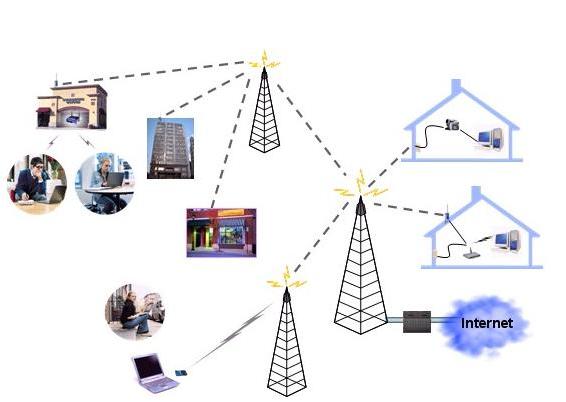
It is a member of the 802 series of the standards developed by IEEE (The Institute of Electrical and Electronics Engineers) and it is a wireless broadband technology that takes the IEEE 802.16 standard as basis. The first IEEE 802.16 standard developed in 2001 was designed for the frequency range of 10 - 66 GHz and it was modified to cover a frequency range of 2-11 GHz in January 2003 and therefore named as IEEE 802.16a, which resulted in having the feature that meets the usage needs having no line of sight (NLOS). The last modifications in the IEEE 802.16 standard was approved in June 2004 under the name of IEEE 802.16-2004 and with this standard, 802.16a, 802.16c and the first ilk 802.16-2001 version was removed from usage. The IEEE 802.16-2004 standard is only for the stabilized systems. The works for the IEEE 802.16e standard that would require mobility constituents and features were completed within 2005 and it was approved on the date of 07/12/2005 under the name of IEEE 802.16-2005 standard. Theoretically, the IEEE 802.16-2004 standard was designed for making the 75 Mbps transmission speed up to 50 km possible without requiring a line of sight and the IEEE 802.16-2005 standard was designed in the form that is able to offer service to the users going with a speed of 120 km/h within a coverage area having a diameter of 6-7 km. In the applications between WiMAX and 2-66 GHz bands, it is possible to make voice, data and visual transmission to far distances as point to point and point to many points (LoS-Line of Sight) and/or any point within the coverage area in high speeds through the IP based Networks with the usage of rather 2.5 GHz, 3.5 GHz and 5.8 GHz. At this point, LoS and NLoS that WiMAX provides wireless service for is awaiting you with its applications and solutions MERIC GROUP ‘alternative quick solutions’. Your technologic solutions partner...
|