logo


IP TV SYSTEMS

DEFINITION

IPTV is a structure used for the distribution of digital television services to the users subscribed for this system. The operation of distributing the Digital Television is implemented with the usage of Internet Protocol (IP) from the broadband connection. The usage of the Internet Protocol is provided from a managed network rather than using the public Internet for the purpose of protecting the offered service quality. IPTV service is offered together with the view-video depending on the user demands. Additionally, it is possible to offer Internet services such as the web access and the voice transmission (VoIP) through the Internet Protocol as a service from the same infrastructure. And by providing internet service, the service is named as the Triple Play.

Today, IPTV is in the agenda of the whole world. The increasing amount of examples concerning the providing of IPTV day by day and its future constitutes the source of interest towards IPTV.

IPTV is a very useful internet service that makes it possible to receive the TV and video signals along with other multimedia service from the point of your internet.


OVERVIEW

It is useful to remember that IPTV is not like broadcasting an ordinary television program through internet. It has a specific essence in itself. It should be considered as a closed structure and private TV system. In detail, the distribution of IPTV for the users is established from the IP based safe channels and this creates the result of a serious increase in the control for the distribution of contents.
IPTV provides the tracing of user options and preferences such as tracing the selections of the preferences in certain hours. Therefore it is an excellent environment for making private advertisements and e-trade. IP is renown as a general naming until now, as a general naming for the systems used for transmitting both television and video signals to the subscribers or to the audiences.
IPTV is a service offered in parallel with the internet connection of the subscriber by an operator that provides broadband access and it uses Internet Protocol (IP). It is used in the same infrastructure with the broadband internet access; however, a band width devoted to the IPTV service draws the attention in this usage. For this reason, we can define IPTV as a system that provides the digital television service from a broadband connection to the subscribed users by using Internet Protocol.

It should be remembered that  IPTV is different from “Internet View”. Internet View provides the service for watching videos such as the film trailers and web cams and it does not include the items such as managing the quality and service in the presentation of the service, whereas IPTV technology is far more advanced, user friendly and is offered in an infrastructure that is intertwined with far higher speed access technologies. Additionally, the IPTV technology provides very attractive opportunities for the telecom service providers. Thanks to this service, the IPTV service provides catch up with the chance to take place in the market segment called “Triple Play” and to participate in the profiting competition. The IPTV service is an efficient and exactly wanted method in the distribution of voice, data and video for both home and business users.


SHORT BACKGROUND

IPTV is basically the combination of voice, video and data service. It is not a new idea or an event. It is a result of the high band width and high speed internet access. The internet speed was not compatible with the structure we talk of now in the earlier times. Recently, the internet speed and the band width increased considerably and this consequently brought about the IPTV domination and its logical success. Additionally, the first set-top-boxes were costing a bomb. The costs in the technologies are offering far more accessible models now.


STRUCTURE

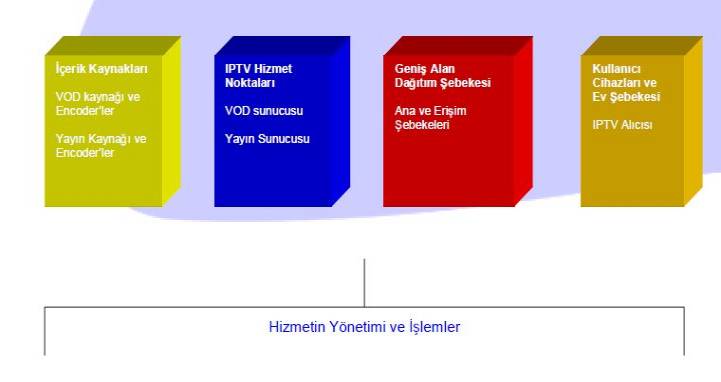
So long as the network to be serviced is ready for this, IPTV is not a very expensive work. It uses internet. It sends data in lower capacity when compared with the standard analog or digital television and therefore it is possible to mention far cheaper costs for both the operator and the end-user. The usage of set-top-boxes provides many benefits in the operation of transmitting video signals. In addition to their high speeds, multiple programs are able to be recorded with the usage of digital video recorders. As in the aforementioned statements of ours, a few additional costs are required for the service of IPTV so long as the required network is ready in order to provide this service. Let’s see what these are.


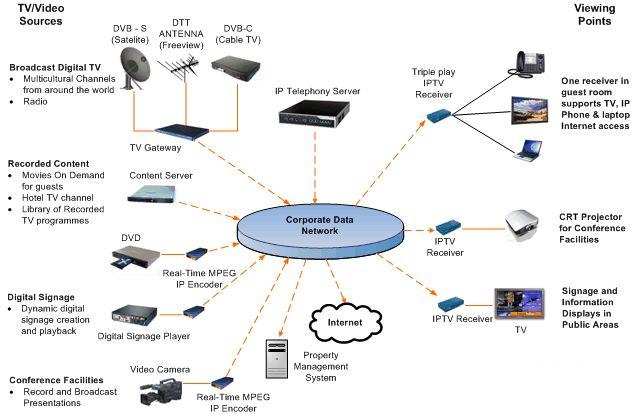
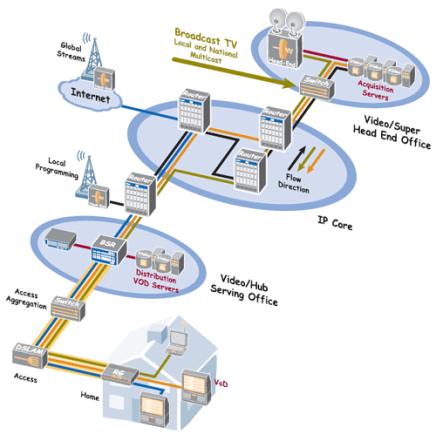
Content Sources: The phrase “Content Source” is defined as the operation of receiving the video content from the producers or the other sources. Thereafter, these contents are encoded and stored on the video-on-demand database.


Service Points: The phrase “Service Point" is used to indicate the operation of receiving the video flow in different formats. Such video flows in different formats are later reformatted and it is subject to the enveloping operation for transmitting along with the indicators that indicate the service quality fitting the wide area distribution network.


Service points from the perspective of service management; is in the state of communication with the device in the hand of the subscriber and additionally, the commencement of the operation and digital rights management.


Wide Area Distribution Network: The principles that the wide area distribution network takes as basis are the distribution ability and the service quality. A wide area distribution network that the IPTV service is demanded to be offered through must have some other abilities as well.
For instance, the multicast ability. The multicast ability is required for providing “reliable” and “on-time” IPTV data flow from the service points to the homes of the subscribers.
Depending on the type of the used network, there are core structures in the distribution points of the network backbone such as the DSLAM in DSL networks or Fiber Node in Cable TV networks.


User Access Lines: High speed technologies are required in the access lines being used.
For instance, the ADSL+ and VDSL technologies for the DSL technologies. With such type of technology, the distribution can be provided to the users through the network available through the telephone lines.
There are also other options. The service providers can also utilize a combination of fiber to the kerb (FTTC) and Cable TV technologies. Moreover, both the DSL and Cable TV operators can establish direct fiber to the home (FTTH) access as well. Along with these, the best result wanted to be achieved is depending on the richness of the services offered by the service providers.


User (Subscriber) Devices: Such devices are the ones located either in the home or office of the end-users, in other words the subscribers. Besides the function of ending the network, they can also have other features integrated to themselves. For instance; routing gateway, set-top-box or creating an in-house network.


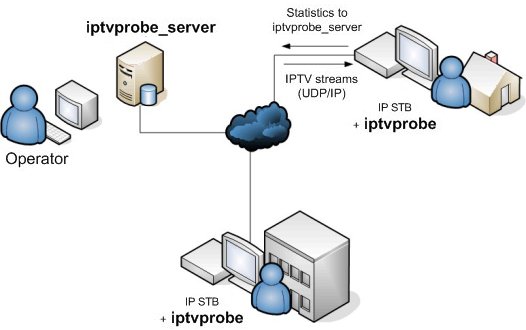
IPTV Receiver: It is the unit that the IPTV traffic ends in the user environment. It is a device known as a receiver/receptor/set-top-box style device. Its functions are installing the connection and service quality with the service point and solving the encoding in the video flow, providing the channel changing, controlling the user screen and providing the connection to the television or monitors located in the homes of the users either in standard or high resolution.


 Comparison of IPTV and Internet Television
Now let’s see the features making IPTV and Internet television different from each other. Actually it is really a difficult task to differentiate these two models. Differences can be explained with a depth study and analysis on this subject.
On one hand the IPTV represents a closed and private TV system. It is offered to the users as IP based safe channels. As a result, the controlling is high in the distribution of the content.
On the other hand, the Internet television has a structure offered by numerous video producers either small or middle scale in an open frame. It is an environment, in which many new contents are prepared comfortably. It is the reason of being an open environment that most classical channels can be provided through this way by means of wide distribution or by retail

 

Applications and Services
IPTV systems are for providing the digital television broadcast and selective VoD service. Such an application provides the service provider an environment (triple play) that the video, voice and data are offered as well.
The infrastructure of IPTV provides possibility for offering additional video applications even after the establishment of IPTV infrastructure.
Now we would like to talk about other applications and services being offered through IPTV.


Digital TV Broadcasting
The subscribers can access the traditional digital television applications from IPTV. Transmitting the Digital TV applications to the subscribers from the cable network is implemented through an upgraded cable network.
Today IPTV provides the possibility for transmitting the subscribers the services, which are far more abundant and far more various and in higher quality than the conventional TV broadcasting and Cable broadcasting. Very high amount of channels and content can be transmitted to the subscribers depending on the "self preferences of the user". The mentality of conventional broadcasting and cable broadcasting are based on the fact that all channels are simultaneously brought to the home of the subscriber whereas with IPTV, only the distribution of the channels watched by the subscribers is made and in practice, IPTV has the potential of providing "unlimited" amount of channels.
IPTV users have the freedom to choose whatever they want to watch and whenever they want to watch. This is possible thanks to the double sided interaction (interactivity) from subscriber to center and center to subscriber. The interaction takes place in natural essence of the IPTV because IPTV takes its name from IP. The subscribers receive a specific service for their homes and work places.


Video on Demand (VoD)
Video on Demand service is the providing of television programs according to the demands of the subscribers. These television services can be prestored movies or educational videos. It has a live access offered from a live connection.
For instance, the real-time news. The VoD application provides the individual subscribers the freedom to selected the video content fitting to their wishes.
Once the IPTV infrastructure is created for once, the potential profit providing services such as IPTV applications and video-phone or video conference, distance learning, distance monitoring of the home for safety purposes and etc. can be offered through this infrastructure. Very advanced level of several additional services and features can be applied from IPTV when compared with the conventional television systems. Such as the Television service, Global Television Channels, Personal Media Channels and Addressable Advertising in any place.
The time shifted TV and Network PVD (personal video recording) and such applications that we consider as VoD are based on the principle of Media Server.
During the time that the IP Television user receives the service, a personal television channel is assigned to the user. Thereafter, the user can record the media on the device and keep it in the device to watch later if she/he wishes.


Addressable Advertising
It is based on the private advertising. By this way, the success rate of the advertisement campaign can be measured easily as well.
With the user’s act of switching the IP television on, the IP television system can ask whether the registered users are willing to choose their names or not. The user therefore selects their predetermined options and profile by selecting their names among the registered users. The preferred advertisements, messages, e-mails, program guides, favorite channels and others.
Thanks to the addressable advertising, it may be possible to get 10 or 100 times more income among the incomes obtained from the conventional broadcasting advertising mentality. By sending a certain amount of advertisements to certain customers the advertising companies can make a stabilized advertising expenses plan. The addressable advertising provides possibility for offering different advertisements to users, despite being located in the same geography.


Integration of Fixed and Mobile Networks
In IPTV, the portal owned by the user is sent to the mobile receiver of the user. Therefore the user can manage his/her IPTV account, order movies or make time adjustment for watching any program whenever he/she wants from his/her set-top-box.
A channel that includes the movie trailers is broadcasted from DVB-H. When the user sees a movie trailer he/she wishes to watch, it possible for him/her to make the desired movie available by pressing an interactive button on the receiver/receptor/set-top-box.


Education
IPTV provides a considerably useful and advantageous environment for education. Considering the large scale courses, there is the offering for an environment that numerous teachers share their video materials. Each teacher can determine a time for the lecturing of the section concerning their fields. The user can receive the lecture in the subject he/she desires most significantly either simultaneously or by recoding on the receiver/receptor/set-top-box upon their wish.
According to the reports announced by the research companies, the service providers are currently involved in an intense work for the compatibility of networks with the future generation television services. The cable operators are making the required investments to have a share from the slice from the cake that the other telecom service operators obtain from telephones and internet, and so are the telecom service operators to have a slice fromt he major TV market.

The growth in the providing of IPTV service in Europe is reported as %250 between 2006 and 2007. From the end of 2007, the amount of users receiving the IPTV service reached 14 million worldwide.

Resources            

International Engineering Consortium                                                     
Parks Associates Synergy  
Research Group      
Thomson GrassValley

For more information: pdf

WISI 

E-mail: meric@mericgroup.com.tr